

Article: What the Ghaf Blossom Carries
What the Ghaf Blossom Carries
A conversation between Dumyé founder Sahar Wahbeh and Emirati botanical artist Haya Alketbi about looking closely, working quietly, and the things that belong to this place.
When Sahar Wahbeh first came across the Ghaf Blossom, she did not go looking for it. She was going down a rabbit hole — the kind she tends to disappear into when something catches her curiosity — researching the botanical heritage of the UAE for a new Dumyé doll she had been quietly developing. The Ghaf kept coming back. Not the tree, which everyone in the UAE knows, but the blossom — small, cream-yellow, blooming twice a year in clusters that most people walk past without ever really seeing.
She started looking for an artist who could paint it properly. Not decoratively, but truthfully, with the kind of precision that makes a small flower feel like it has been fully seen for the first time.
What she eventually found, buried in the pages of the Royal Botanic Garden Edinburgh’s 2022 graduate show, was an Emirati woman named Haya Alketbi, who had spent a year in Edinburgh studying scientific botanical illustration and had chosen, for her entire diploma project, to document the native plants of the UAE.
What neither of them knew at the time of connection was that Haya had already been sketching the Ghaf. It was already on her list.
Reading Haya's words later, Sahar kept returning to one thought. Haya was talking about plants. But she could just as easily have been talking about us. "The more closely I study, the more I realize that no plant exists entirely on its own." Neither do we.
Sahar, when you started researching the Ghaf Blossom, what did you actually find?
Sahar: I found something I wasn't expecting. I knew the Ghaf tree — everyone here knows the Ghaf tree. It's the national tree, it's everywhere, it's on everything. But I had never really stopped to look at the flower. I didn't even realize they had flowers. And these flowers produce nectar for a high-quality local honey that is considered a delicacy. Who knew? Not me. So I went deeper. The roots go thirty meters into the sand to reach water. It shelters everything near it without asking anything in return. It doesn't stand above the landscape — it protects it. The more I read, the more it reminded me of a particular kind of woman. The kind who makes space for others without making a show of it. And that was when I decided I wanted to share it with the women who had done the same for Dumyé.
"It felt less like a commission and more like a convergence. I had been preparing to look at this flower more closely. Sahar arrived at exactly that moment and asked me to." - Haya Alketbi
Haya, the Ghaf was already part of a project you were working on before the commission arrived. Can you tell me about that?
Haya: I have been working for some time on a personal project to document and illustrate the native flora of the UAE — plant by plant, through the full cycle of the year. For each species I choose a particular plant as my main study specimen and follow it closely — its form, its flowers, the development of its fruit, its seeds, the seasonal changes that connect all of those stages. The Ghaf was already among the plants I had begun observing. So when Sahar’s message came, it felt less like a commission and more like a convergence. I had been preparing to look at this flower more closely. She arrived at exactly that moment and asked me to.
And when you looked at the Ghaf Blossom up close for this commission — what did you find?
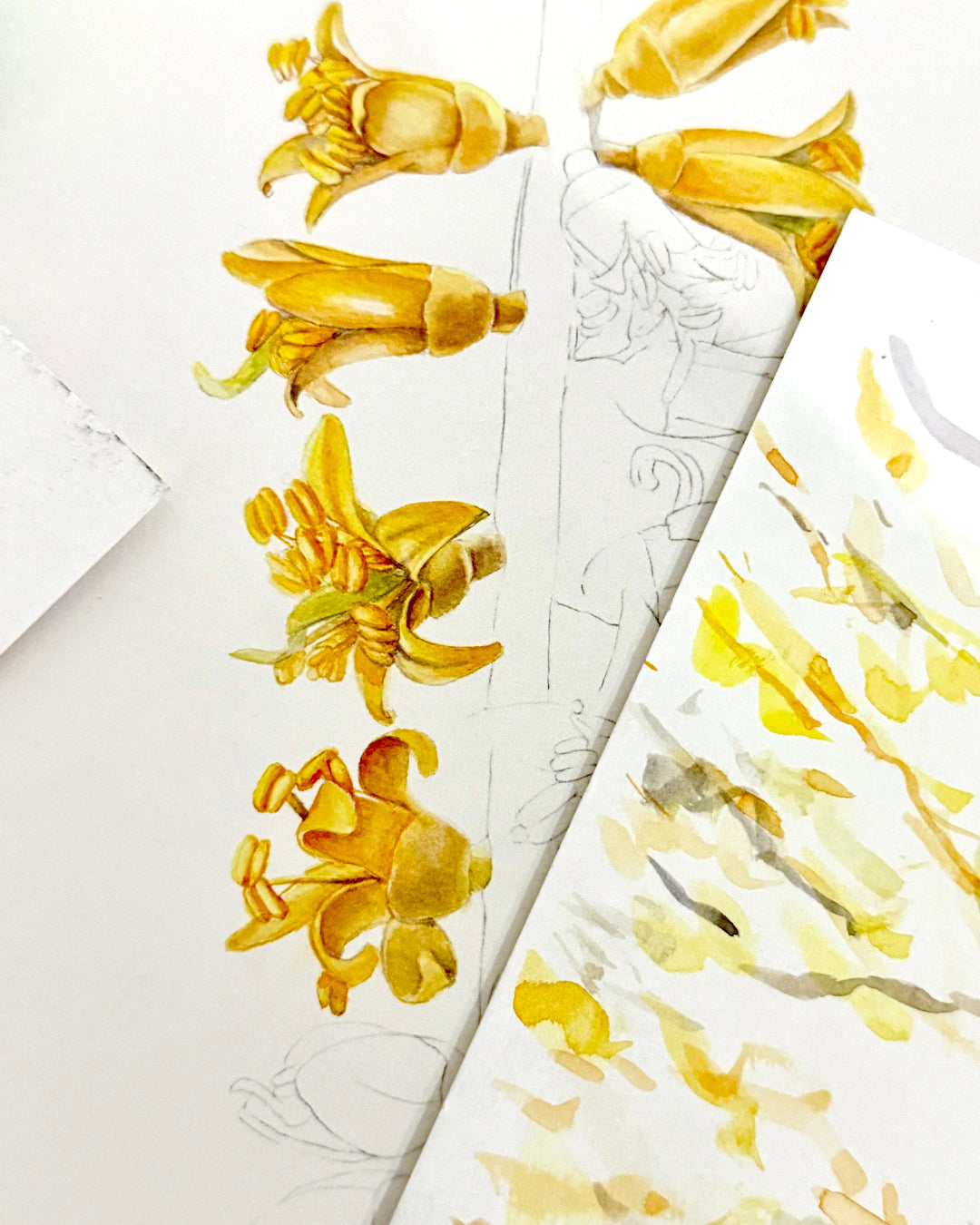
Haya: Looking at the flowers at such close range revealed a level of complexity that is very easy to miss when we see a Ghaf tree in the landscape. What appears from a distance as a simple yellow flower spike is, on closer examination, made up of many tiny individual flowers, each with its own structure and detail. That change of scale — from seeing the Ghaf as a familiar tree in the landscape to discovering the architecture of its smallest flowers — was perhaps what surprised and fascinated me most.
The illustration in progress — Haya Alketbi, 2026
Sahar, finding Haya was not straightforward. What was that search like?
Sahar: Honestly, it was a little obsessive. I knew what I was looking for but I couldn’t find it. I looked at so many talented artists. And then I found the RBGE graduate show page and there she was — an Emirati woman who had spent a year in Edinburgh studying this specific discipline, who had chosen UAE native plants as her focus. I tried to find her everywhere. I found two people on Instagram who had her name, both Emirati, both connected to Edinburgh, and I sent them both a slightly embarrassing message explaining what I was looking for. One of them wrote back and said very kindly that she wasn’t the person I was looking for but she hoped I found her. Then I called the school in Edinburgh. They said they couldn’t give me her details but they would forward an email. So I wrote it, and I waited. And thankfully she wrote back.
What appears from a distance as a simple yellow flower spike is, on closer examination, made up of many tiny individual flowers, each with its own structure and detail. - Haya Alketbi
Haya, what made you choose UAE native plants for your RBGE diploma project in the first place?
Haya: My background began in science, and I spent part of my professional life as a science teacher. I have always been interested in the structure of plants and in understanding why they grow and adapt the way they do. When I later began studying botanical illustration more seriously, choosing UAE native plants felt very natural to me. These plants are around us, yet we often pass them without really seeing them. Many survive in extraordinarily demanding conditions, and when you begin to study them closely, you discover an incredible amount of complexity and beauty. For my RBGE diploma project, I wanted my work to be connected to the place I call home and, in a small way, to contribute to documenting its botanical heritage through art.
When you are illustrating a plant, what are you actually looking for? What does the process feel like?
Haya: I think I am looking for the character of the plant, but also for its place within its environment. For me, understanding a plant begins before I start drawing. I like to observe it in its natural habitat — the conditions in which it grows, the plants that surround it, and the relationships it forms within that environment. I am interested not only in how the plant has adapted to its surroundings, but also in how it influences and interacts with the ecosystem around it. This wider context helps me understand the plant as a living organism rather than simply as a specimen to be illustrated.
When I begin drawing, I look closely at its structure, proportions, growth patterns, colour and the smallest botanical details. But observation gradually becomes something more than recording information. After spending hours with a plant, you begin to understand its rhythm — how the leaves sit on a branch, how a flower opens, how new growth differs from older growth, and where the plant appears delicate or resilient.
For me, the process is quiet and deeply absorbing. Botanical illustration forces me to slow down, observe carefully, and notice things that would be almost impossible to see in a quick glance. In a way, drawing becomes another form of studying the plant — and the more closely I study it, the more I realise that no plant exists entirely on its own.
 Individual floret studies — Haya Alketbi, 2026
You trained in Edinburgh, you teach Islamic art, you were a science teacher, and you illustrate UAE native plants. How do those worlds sit together for you?
Haya: To me, they are not separate worlds. Science taught me to observe, question and understand structure. Botanical illustration taught me to translate that observation into an image while remaining faithful to the plant. Islamic art taught me another way of looking at nature — through rhythm, proportion, repetition and the transformation of natural forms into artistic language. Perhaps the common thread between all of them is observation. Whether I am studying the geometry and movement of an Islamic ornament or examining the arrangement of leaves on a native plant, I am looking for structure, balance and relationships. Each discipline has changed the way I see the others.
Perhaps the common thread between all of them is observation. Each discipline has changed the way I see the others. - Haya Alketbi
Sahar, what does it mean to you to have commissioned an Emirati artist for this project specifically?
Sahar: It was never not going to be an Emirati artist. That was not even a question. I have been in the UAE for over twenty years. I have been welcomed here, championed here, given opportunities here — by Emirati women in particular, more times than I can count. When I was thinking about what to offer our community for Emirati Women's Month, I wasn't thinking about a product. I was thinking about what would feel true to how I actually feel about this place and the people in it. An Emirati artist painting an Emirati flower felt right in a way that went beyond aesthetics. It felt like the whole thing was coming from the right place.
Haya, what would you want someone to notice when they look at what you created?
Haya: The Ghaf Blossom was already part of my botanical documentation project, and I had begun studying it through sketches and preliminary observations, waiting for the right time to develop it into a finished illustration. Sahar's commission gave me the opportunity to take those early studies further and bring the blossom into a fully realised botanical artwork. What I would like someone to notice is the extraordinary detail within something so small and familiar. When seen on the tree, the blossoms can easily merge into the overall presence of the Ghaf, but when studied closely, they reveal an intricate structure and a beauty of their own. I hope the illustration encourages people to pause and look more closely — not only at the Ghaf Blossom, but perhaps at the native plants around them with a little more curiosity and attention.

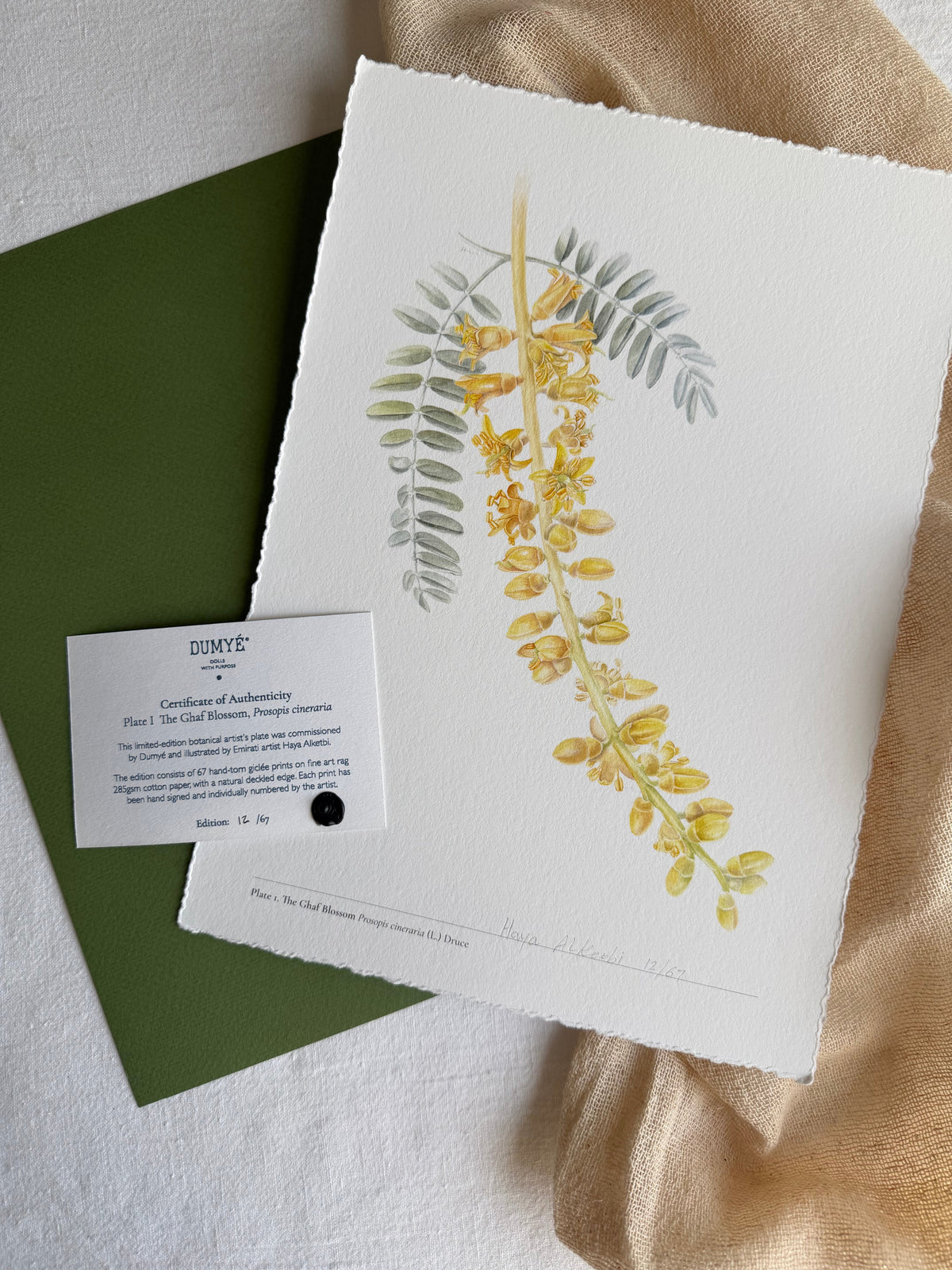
Detail — Plate I, The Ghaf Blossom · Haya Alketbi for Dumyé, 2026
And Sahar — what does the Ghaf Blossom carry, for you?
Sahar: It carries the thing I keep coming back to with Dumyé. That the most meaningful gifts are the ones that hold a story long after they are received. The Ghaf Blossom carries the UAE. It carries the women who have held things together quietly, for a long time, without asking to be noticed. It carries Haya’s years of patient looking. And now it carries something else — the beginning of a doll, who is coming at the end of this November, and who will carry all of it forward in a different form. A small thing that contains a much larger one. That is, I think, what Dumyé has always been trying to make.
The Ghaf Fairy
A new Designer Dumyé doll inspired by the Ghaf Blossom, launches November 2026. Join the waitlist for a chance to win an original signed print from the edition that inspired her.
| Join the Waitlist |

Plate I — The Ghaf Blossom, Prosopis cineraria. Illustrated by Haya Alketbi for Dumyé, 2026. Edition of 67.


Leave a comment
This site is protected by hCaptcha and the hCaptcha Privacy Policy and Terms of Service apply.